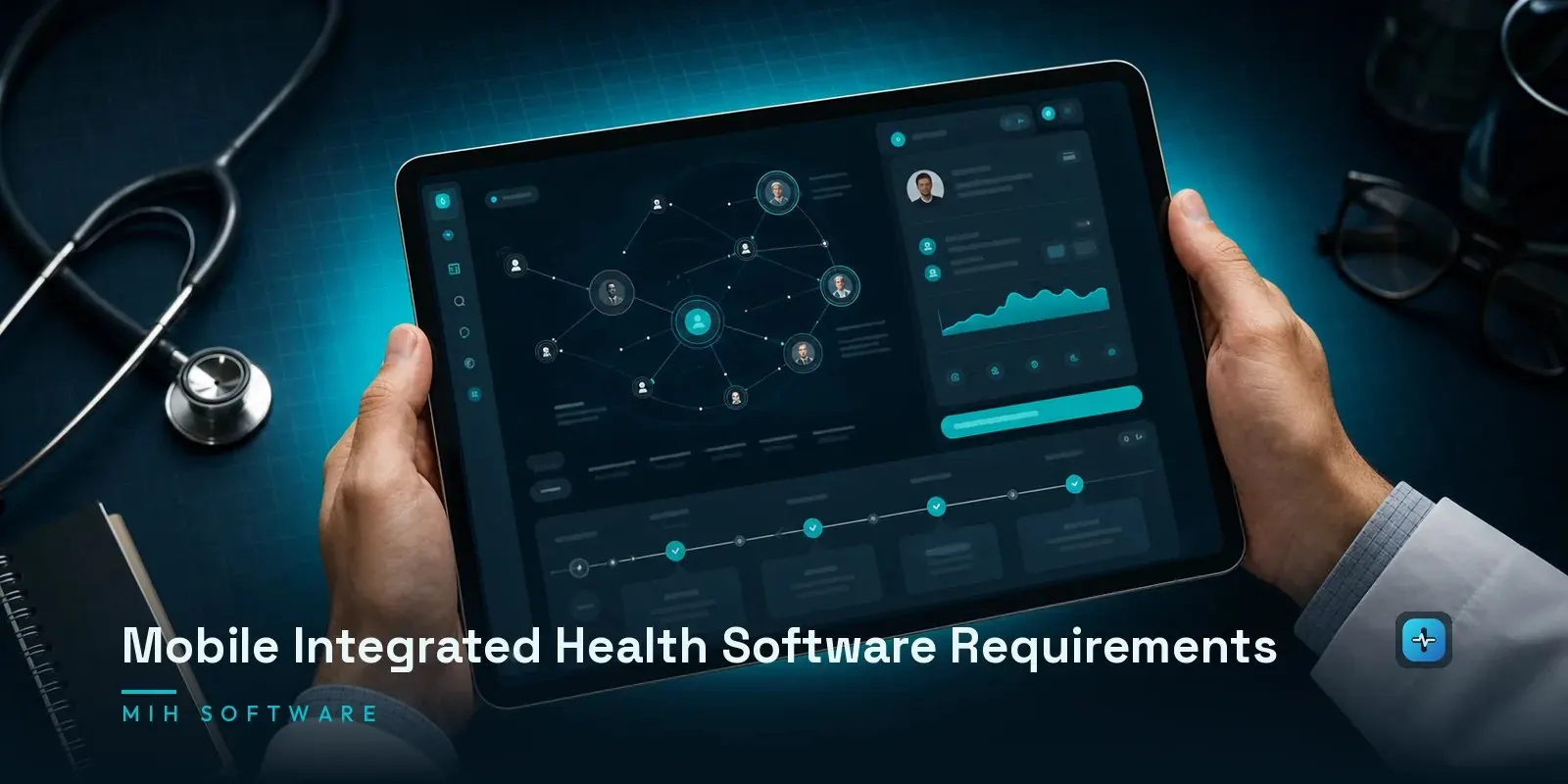
Mobile integrated health describes an EMS-based care model that extends beyond emergency response into coordinated, often preventive care delivered in the home, and its defining software requirement is multi-party data sharing rather than longitudinal record-keeping alone. An MIH program typically involves partners that each hold part of the picture — a hospital system referring recently discharged patients, a payer funding the intervention, behavioral health and social service organizations receiving referrals, and the EMS agency doing the visits. Making that work means the software has to exchange data across organizational boundaries under different consent regimes, which is where these programs usually stall: a referral from a behavioral health partner may carry 42 CFR Part 2 restrictions, a hospital partner will expect data back in a form its EHR accepts, and the payer will want outcome reporting neither of the others produces.
How Is MIH Different From Community Paramedicine?
These two terms overlap heavily and get conflated constantly, so it’s worth being precise: NAEMT itself typically treats them as a joint model, “mobile integrated healthcare – community paramedicine (MIH-CP),” defined as the provision of healthcare using patient-centered, mobile resources in the out-of-hospital environment. In practice, the distinction that matters for software is scope of partnership. Community paramedicine, which we cover separately, centers on the EMS agency delivering longitudinal, scheduled care directly to patients. MIH programs typically involve a wider, more formal network of partners — hospitals, payers, behavioral health and social service organizations — each with their own systems, consent requirements, and reporting needs. A community paramedicine program can exist without much of that multi-partner complexity; a mature MIH program usually cannot avoid it.
The Multi-Partner Problem
Per NAEMT’s own national survey data, hospitals are the most common referral source into MIH-CP programs, followed by primary care facilities and physician groups — and nearly every program surveyed reported addressing behavioral health in some capacity, with several building or expanding dedicated crisis-response integration. That real partner map — hospital referrals in, behavioral health and social service referrals out, a payer funding and expecting outcome data, and the EMS agency coordinating all of it — is the actual software problem. Each partner holds a different slice of the patient’s picture, uses a different system, and operates under a different consent and data-sharing regime, and the software has to reconcile all of that without becoming the single point of failure for the whole program.
Consent Across Organizational Boundaries
This is where most of the real friction lives. A referral involving substance use disorder treatment carries 42 CFR Part 2 protections — a materially stricter consent regime than standard HIPAA, requiring specific patient consent for each disclosure in most circumstances, which we go through in full in 42 CFR Part 2: what it means for your software. A behavioral health crisis referral may carry its own state-specific protections on top of that. Meanwhile a standard hospital or payer data exchange typically operates under ordinary HIPAA treatment/payment/operations rules. Software supporting an MIH program has to correctly apply the right consent regime to each specific data flow — not one blanket policy — which is a genuinely harder design problem than most single-partner healthcare software ever has to solve.
Getting Data Back to a Hospital Partner
A hospital partner referring patients into an MIH program will generally expect outcome and encounter data back in a form its own EHR can actually ingest — typically HL7 or FHIR-based, per the standards we cover in our FHIR vs. HL7 v2 comparison and the broader interoperability landscape in EHR interoperability: what makes systems actually talk. An MIH platform that can only export a PDF summary or a proprietary report format creates real friction for the hospital partner whose continued referrals the program depends on — and a hospital that can’t easily see what happened after a referral is a hospital less likely to keep referring.
Payer and Outcome Reporting
Payer involvement in MIH has grown substantially — NAMIHP now recognizes specific “Payor Champion” health plans each year for advancing MIH reimbursement and partnership models, which signals real, if still uneven, movement toward payer-funded MIH. A payer funding an MIH intervention wants outcome reporting tied to the specific population and intervention it’s paying for — readmission avoidance, cost offset, utilization change — which is a distinct reporting requirement from what a hospital partner or a grant funder needs. Software that treats “reporting” as one generic export rather than partner-specific, outcome-oriented reporting will eventually fail to satisfy at least one of these stakeholders.
Where MIH Programs Stall
Being honest about this: MIH programs most often stall on data-sharing agreements between organizations, not on technology. Negotiating what data flows where, under what consent, and who’s liable for what takes real institutional time between legal and compliance teams at multiple organizations — and that negotiation has to happen before the software architecture can even be finalized. Software can make the technical implementation of a data-sharing agreement smooth once it’s negotiated; it can’t shortcut the negotiation itself. Building flexible, partner-specific data-sharing and consent handling into the software from the start at least avoids adding a second, technical bottleneck on top of the institutional one.
Next Steps
If you’re building software for an MIH program, design around the multi-partner data-sharing and consent problem from day one — it’s the defining requirement, not an edge case to handle later. See our companion post on community paramedicine software for the closely related longitudinal-record problem, and our EMS/ePCR hub for all our EMS and ePCR guides. If you’re scoping a multi-partner integration for an MIH program, our team can help — reach out.