Most chiropractic practices don’t go looking for new EHR software because they woke up wanting a project — they go looking because the system they have is slowing down a Tuesday afternoon full of patients, or a biller just spent an hour untangling a package-billing error the software should have caught. If that’s you, the buyer’s guides written for general medicine won’t help much. Chiropractic care runs on a different rhythm than a typical medical practice — more visits per patient, faster documentation, and a billing mix most general EHRs were never built to handle — so it’s worth evaluating chiropractic EHR software against what the specialty actually needs, not a generic checklist.
Does it support fast, repeatable SOAP-note charting built for spinal care?
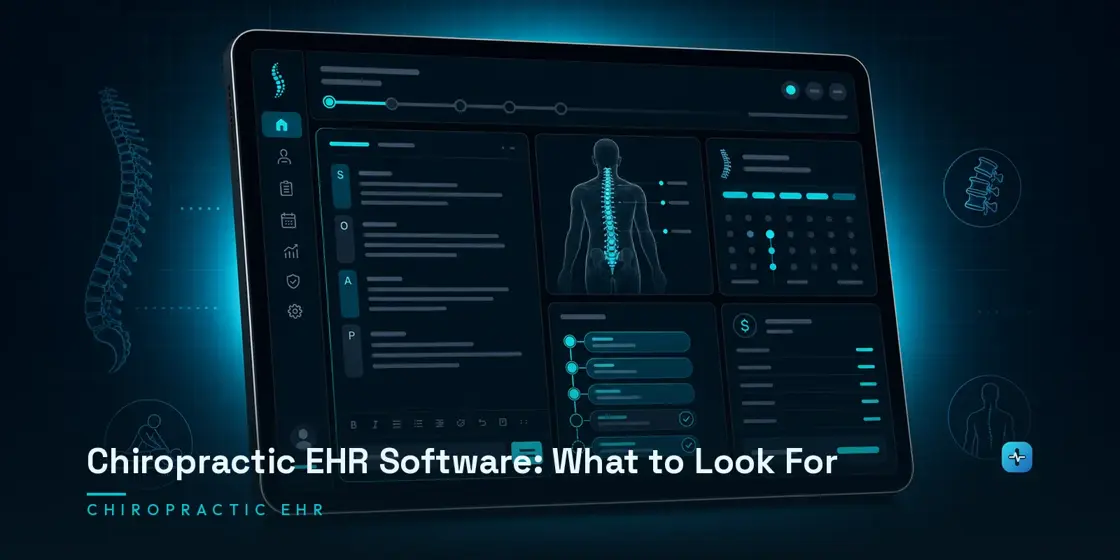
A chiropractic visit note isn’t a fifteen-minute physical. It’s a fast, structured record of a specific region of complaint, adjustment technique, and patient response — repeated many times a day, often for the same patient over weeks. Good chiropractic EHR software gives you SOAP-note templates built around that reality: body-diagram charting, pre-built adjustment and technique shortcuts, and a note that a doctor can complete in under a minute without it turning into a rubber-stamped copy of yesterday’s visit. If the templates feel adapted from a general medical exam with a few fields relabeled, expect that friction to show up in every note, every day, for as long as you use the system.
Does it track care plans and re-exams across a full course of treatment?
A single visit note is only half the picture. Chiropractic care is delivered as a plan — an initial course of care with a scheduled re-exam, then a maintenance phase, then another re-exam — and the software should track that arc, not just store a stack of individual visit notes. That means visit-frequency tracking against the plan, automatic re-exam reminders, and outcome measures (pain scales, range-of-motion, functional status) charted across the full plan so a doctor can see whether a patient is actually improving, not just whether they showed up.
Does the billing model match how chiropractic actually gets paid?
This is where a lot of general EHRs quietly fail chiropractic practices. Insurance claims are only part of the revenue picture — package pricing for a course of care, membership or wellness-plan billing, and cash-pay visits are all common, often for the same patient at different points in their care. Software built primarily around insurance-claims billing tends to handle everything else as a manual workaround: spreadsheets tracking package balances, front-desk staff doing cash-pay math by hand. If your billing team is maintaining a side system just to make the software’s billing model work, that’s the software’s problem, not a training issue.
Can the front desk keep up with high visit volume?
Chiropractic practices routinely run a higher daily visit count per provider than most medical specialties, which means scheduling, check-in, and payment collection all need to move fast without creating errors. A patient-facing scheduling and portal experience that lets patients book, confirm, and pay ahead of the visit takes real load off a front desk that’s already managing a packed day — and it matters more for chiropractic than for a practice seeing a fraction of the daily patient volume.
Is it actually HIPAA compliant, or just labeled that way?
“HIPAA compliant” gets printed on a lot of marketing pages without much behind it. What actually matters is whether patient records are encrypted in transit and at rest, whether access is scoped by role instead of wide open to every staff login, and whether the system keeps an audit log of who viewed or changed a record and when. Those aren’t features you can bolt on after the fact — they’re architecture decisions that shape the whole system, which is exactly the case we lay out in our HIPAA-compliant app development guide. If a vendor can’t clearly explain how their encryption, access controls, and audit logging actually work — not just that a compliance box got checked — treat that as a real red flag, not a technicality.
What should you do if your current system is missing these?
If your current software is missing several of the things above, there are really three paths. You can petition the vendor for a roadmap fix, which is slow and rarely prioritized for a specialty that’s a small slice of their customer base. You can layer workarounds on top — the spreadsheet-for-billing, the manual re-exam tracking — which costs staff time indefinitely and adds error risk every week it continues. Or you can build chiropractic-specific EHR software shaped around how your practice actually runs, which is worth taking seriously once the workaround cost starts outweighing what a build would cost. A custom EHR doesn’t have to mean starting from a blank page either — most practices are better served by a modular first version covering charting, scheduling, and billing, with anything else added once the core system is live.
The bottom line
Chiropractic EHR software should be judged against how the specialty actually operates: fast, repeatable SOAP charting for spinal and musculoskeletal care, care-plan and re-exam tracking across a full course of treatment, a billing model that handles packages and cash-pay as well as insurance, and front-desk tools built for a higher daily visit volume — all of it genuinely HIPAA compliant, not just labeled that way. If your current system is missing more of these than it’s getting right, or you want a straight opinion on whether a custom build would actually pay off for your practice, talk to us.