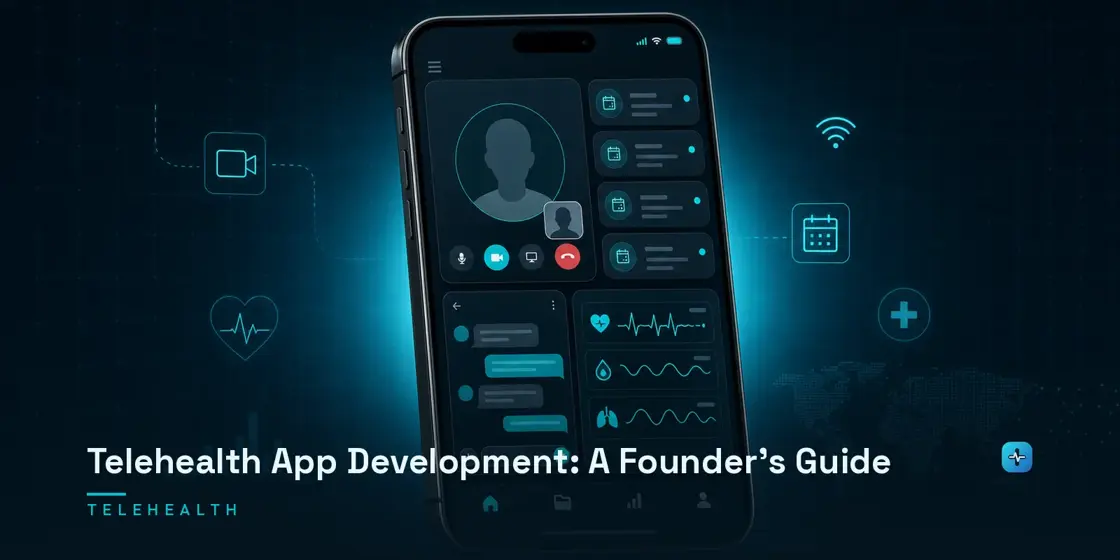
Telehealth looks simple from the outside: a video call, a scheduling link, maybe a chat box. Then a founder actually scopes the build and discovers that “simple” was never the right word — it was just the part patients see. Underneath the video window sits a Business Associate Agreement with whoever hosts that video, an access-control system that keeps a patient’s visit private from every other patient’s, an audit log of who viewed what and when, and a pipe back into whatever EHR your clinicians already use, because a visit note that lives outside the chart doesn’t count as documentation. Telemedicine app development is a real product category with its own failure modes, not a video call with a healthcare skin on it. Here’s what actually goes into building one, in the order most founders hit these decisions.
What does telehealth app development actually involve?
A telehealth product is really three systems wearing one interface: intake and scheduling before the visit, HIPAA-compliant video and messaging during it, and documentation that lands in the patient’s record afterward. Miss any one of the three and the product looks fine in a demo and breaks in production. Scheduling has to reserve a slot, send reminders, and — critically — know which provider is licensed to see that patient in that state. The video layer has to hold up on a patient’s five-year-old phone on hotel Wi-Fi, not just on your own test device on office broadband. And the visit note has to reach the chart the same day, or your clinicians end up keeping a shadow spreadsheet, which is its own compliance risk. Founders who scope only the video call are scoping about a third of the actual telehealth app development work.
What makes a telehealth app HIPAA compliant?
Compliance isn’t a checkbox on the video vendor’s pricing page — it’s a property of the whole system. Three things have to be true before a telehealth app can legally handle a real patient visit:
- A signed Business Associate Agreement (BAA) with every vendor that can touch PHI: your video infrastructure, your hosting provider, your SMS or push-notification service, even your analytics tool if it sees patient names. A vendor without a BAA is a vendor you can’t legally use, however good their consumer video SDK looks in a demo.
- Encryption in transit and at rest, on the video stream, the chat messages, and the visit notes — not just on the database column marked “sensitive.”
- Role-based access control and an audit log, so a patient’s visit is visible only to their care team, and every read or write to that visit record is timestamped and attributable to a specific user.
These are the same three requirements that apply to any HIPAA-compliant build — we cover the full picture in our HIPAA-compliant app development guide — telehealth just adds a live video/audio stream to the list of things that need a BAA and encryption, on top of the data at rest.
Native app, web app, or both?
This is usually the first real fork in the road, and it’s worth deciding deliberately instead of defaulting to “build an app” because that’s what founders assume telehealth means.
A native iOS app wins on reliability: push notifications that actually get seen, dependable camera and microphone access, and offline-capable intake forms a patient can fill out before they have signal in the waiting room. If most of your volume is patients who’ll use the same app repeatedly — a chronic-care program, a behavioral health practice with weekly sessions — the native experience pays for itself. Our native iOS app development work is built specifically around that kind of repeat clinical use.
A browser-based visit wins on friction: no app-store download, no update prompt, just a link a patient taps from a text message five minutes before their appointment. For a one-off urgent-care visit or a specialist consult a patient will use once, that’s usually the better call. Nothing forces an either/or choice here — we regularly build both against the same backend, so a practice can send app users to the app and everyone else to a browser link without maintaining two separate systems.
Build vs. white-label video SDK — where the budget actually goes
The most expensive mistake in telehealth app development isn’t a technical one — it’s re-solving a problem that’s already been solved. Building your own video and audio stack from scratch means owning codec selection, bandwidth adaptation, and connection reliability across every device and network condition a patient might be on, which is a multi-year problem even for well-funded teams. Almost every telehealth product we build instead sits on top of a HIPAA-compliant video infrastructure provider, under a signed BAA, and puts the actual engineering budget where it’s specific to your practice: scheduling logic, intake workflows, and — the part that gets skipped most often — the connection back to your EHR. That reallocation is usually the difference between a six-month build and an eighteen-month one, and it doesn’t cost you anything on the compliance side, since the BAA still covers the video layer either way.
Why the EHR connection is the part that gets underbuilt
A telehealth visit that isn’t in the patient’s chart didn’t happen, as far as continuity of care is concerned. The most common mistake we see in telehealth builds that come to us for a rebuild isn’t in the video layer — it’s a visit history that lives only inside the telehealth app, disconnected from everything else a clinician sees about that patient. Fixing that after the fact means backfilling months of visit notes by hand. Getting it right from the start means treating a telehealth visit as just another encounter type inside your existing clinical record, synced through the same EHR & EMR integration layer that handles every other data flow in and out of your system — built on the same HL7/FHIR foundation, with the same audit-ready logging any HIPAA compliance audit checklist will ask you to produce.
The bottom line
Telehealth app development is genuinely three products — intake and scheduling, HIPAA-compliant video, and EHR-connected documentation — wearing one interface, and the founders who scope all three up front are the ones who ship something that survives contact with real patients and real audits. Lean on an existing HIPAA-compliant video infrastructure provider instead of building one from scratch, decide deliberately between native and browser-based (or both), and treat the EHR connection as core scope, not a phase-two afterthought. If you’re scoping a telehealth build and want a straight answer on what that actually costs and how long it takes, get in touch — we’ll walk through the tradeoffs before you commit to either.